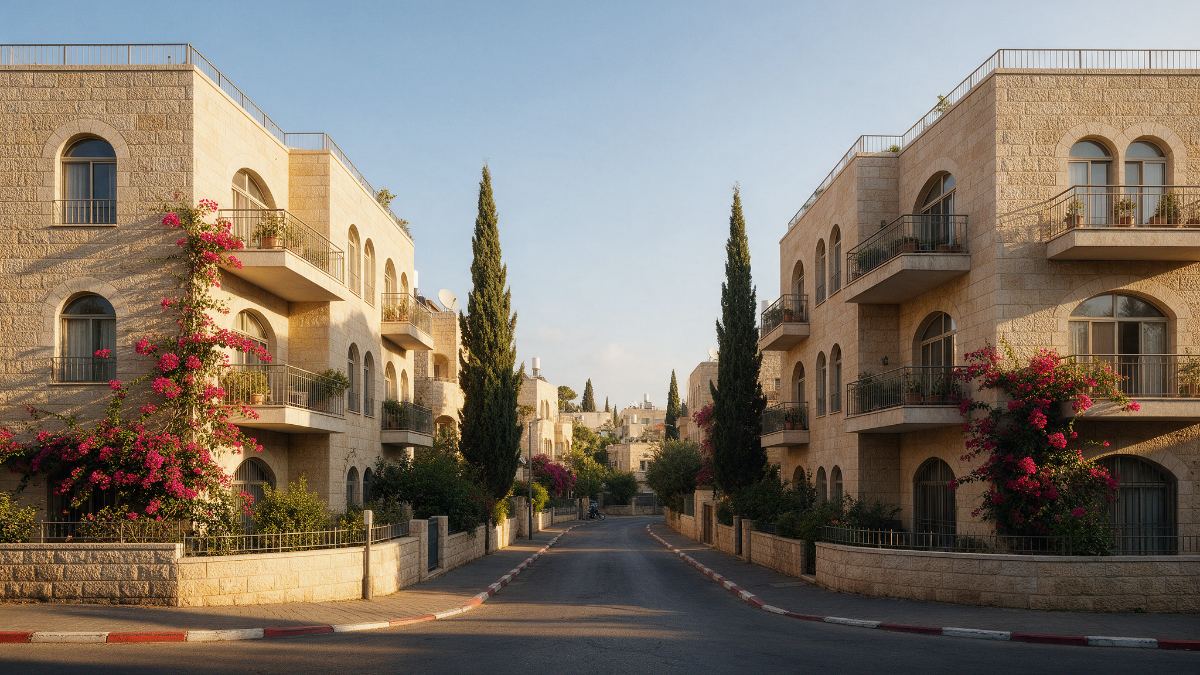
Buying in German Colony (Jerusalem): 2026 prices, properties, due diligence
The German Colony (Moshava Germanit) is the most photographed neighbourhood of Jerusalem outside the walls: the red-tiled stone houses built by German Templers in 1873 along Emek Refaim, the cafés and restaurants, the Smadar cinema, twenty-five minutes on foot from the Old City. It is also one of the most tightly preserved neighbourhoods, and the one where the Blue Line light-rail works on Emek Refaim change the picture for a few years.
The short answer
In the German Colony, resale trades between ₪42,000 and ₪55,000 per m² in 2026 and boutique new builds between ₪55,000 and ₪70,000: a 3-room, 85 m² apartment is worth ₪3.6–4.5M (≈ $1–1.25M), a 4-room, 105 m² apartment ₪4.5–6M, a Templer or Arab house apartment with garden ₪6–12M. On a 3-room unit at ₪4.1M a non-resident pays 328,000 ₪ in purchase tax (mas rechisha), a resident buying their only home 100,538 ₪, an oleh 10,606 ₪. Founded in 1873 by German Templers, 25 minutes on foot from the Old City; strict preservation, very little new stock, and light-rail works on Emek Refaim that weigh on the avenue until the line opens.
The figures to remember, November 2026
- ₪/m² resale
- 42,000–55,000
- ₪/m² new / boutique
- 55,000–70,000
- 3 rooms, 85 m² gross
- ₪3.6–4.5M
- Works discount, buildings on Emek Refaim
- 5–10%
- Purchase tax, non-resident, on ₪4.1M
- 328,000 ₪
- Gross rental yield
- 2.7–3.2%
The neighbourhood: the German Colony
The Colony was founded in 1873 by the Templers, a Protestant community from Württemberg who built along the Bethlehem road, today Emek Refaim, stone houses with red-tiled roofs, biblical verses carved on the lintels, walled gardens, a school and a cemetery. Expelled by the British in 1939–48, they left a neighbourhood that well-off Arab families had already extended south and east with 1920s–40s villas. Since 1948 the houses have been divided into apartments, and from the 1980s the Colony became the most sought-after address in the south of the city.
The streets: Emek Refaim, the avenue of cafés, restaurants, boutiques and the Smadar cinema; to the west, Lloyd George, Cremieux, Masaryk and Hananya, the quietest and most expensive; to the east, Rachel Imenu and the streets running down to Baka; to the north, the First Station (Tachana Rishona) and the railway park; to the west, Old Katamon. Distances: Jaffa Gate and the Old City 25 minutes on foot via King David Street, Rechavia and the theatre ten, the Red Line light rail on Derech Hevron ten minutes, the future Blue Line on Emek Refaim itself. Synagogues: Yael (English-speaking, one of the busiest in the neighbourhood), Shira Hadasha (partnership minyan), and the French-speaking synagogues of Baka five minutes away. Population: settled Anglos and French speakers, academics, diaspora retirees, and a high share of foreign owners.
Property types and prices by size
| Property | Gross area | 2026 price | What to know |
|---|---|---|---|
| 2 rooms, 1950s–70s building | 50–60 m² | ₪2.3–2.9M | The typical pied-à-terre; no elevator or parking. |
| 3 rooms, renovated stone building | 75–90 m² | ₪3.6–4.5M | The most liquid product; check the building’s listing status. |
| 4 rooms, 1960s–80s building with elevator | 95–115 m² | ₪4.5–6M | Families; parking rare, no safe room unless recently added. |
| 4–5 rooms, boutique project | 110–150 m² | ₪6.5–10M | 6 to 12 apartments on a freed-up plot; elevator, parking, safe room; ₪55,000–70,000 per m². |
| Templer or Arab house apartment with garden | 100–200 m² + garden | ₪6–12M | Listed; high ceilings, stone, a garden whose ownership must be checked. |
| Whole Templer house | 250–400 m² + plot | ₪15–30M | A few transactions a year; diaspora; works under control. |
Price per m² is quoted on gross area: a 3-room apartment listed at 85 m² offers 68 to 72 m² of living space, about 730–775 sq ft (see gross vs net square meters). In old houses with 60 cm walls the gap exceeds 20%.
Who buys in the German Colony
The neighbourhood shares the diaspora market with Rechavia: Americans, British, Canadians, French and Swiss who want an apartment with character in a walkable neighbourhood, within reach of the Old City for the holidays. A share of these homes stays empty most of the year; the municipality has counted several thousand dirot refaim ("ghost apartments") in the centre and south of the city and since 2024 applies a higher arnona (municipal tax) rate to unoccupied homes. Settled Anglo olim are the second group: they buy a 3–4 room apartment after a few years of renting, often at the 0.5% oleh tax rate. Affluent Israelis, finally, academics, doctors and professionals who want the Colony for its cafés and its calm.
Gross yield is low, 2.7 to 3.2%, and resale targets the same international public, which makes the neighbourhood less sensitive to Israeli interest rates and more sensitive to exchange rates and the diaspora’s own economy.
Worked example: a 3-room apartment bought by a non-resident
| Price | ₪4,100,000 |
| Purchase tax, non-resident (8%) | 328,000 ₪ |
| Lawyer (0.5 to 1% + VAT) | ≈ ₪36,000 |
| Agency (2% + VAT) | ≈ ₪97,000 |
| Mortgage broker, appraisal, bank fees, insurance | ≈ ₪20,000 |
| Translations, power of attorney, apostille, wires | ≈ ₪6,000 |
| Total cost | ≈ ₪4,587,000 (+ 11.9%) |
| Mortgage at 50% | ₪2,050,000 → ≈ ₪11,600 / month over 25 years |
| Cash to plan for | ≈ ₪2,537,000 (≈ $705,000 / £552,000) |
The same apartment bought by a resident as their only home would carry 100,538 ₪ in tax; by an oleh hadash, 10,606 ₪. A non-resident who makes aliyah within two years of the purchase can claim the difference back. Unlike a US closing, there is no title insurance, escrow fee or transfer tax beyond this. The schedule is in mas rechisha 2026, 50% financing in mortgages for non-residents, and the UK-specific steps in buying property in Israel from the UK.
Neighbourhood-specific due diligence: preservation, Templers, light rail
- Strict preservation. The German Colony was one of the first Jerusalem neighbourhoods covered by a municipal preservation plan: listed Templer and Arab houses, protected façades, tiled roofs, boundary walls, sometimes trees and gardens. Any extension, opening or added floor goes through the preservation department; an apartment sold "with building rights" has them only if the planning file (tik binyan) confirms it in writing.
- Divided houses. Most 1873–1948 houses have been split into two to six apartments, sometimes without up-to-date by-laws: gardens "attached" by use, basements, attics and roofs unallocated. The lawyer checks the takanon (by-laws) and the division plan; what is not registered on your unit is not yours.
- Unpermitted additions. Enclosed balconies, attic rooms, verandas, splits: compare permit and reality. Regularisation in a listed building may be refused, in which case the addition must come down; write the clause into the contract.
- Chain of title. Templer property transferred to the State after 1948 (and compensated under the 1962 German-Israeli agreement), absentee property, successive sales: the Tabu extract (nesach tabu) must show a complete chain down to the seller.
- Blue Line works. The light-rail works on Emek Refaim (started in 2024–2025, several years planned) affect buildings fronting the avenue: noise, access, closed shops, a temporary 5–10% discount. Ask for the known schedule and visit at different hours.
- Parking. Almost non-existent in older stock, regulated residential parking; a space in a boutique project costs ₪200,000–300,000 and must be registered on the unit.
- No zikaron dvarim without a lawyer. The pre-agreement is binding. Fees and the city-specific checks are in real estate lawyer in Jerusalem.
Renting out in the Colony: long or short term
Long term, a renovated 3-room apartment rents for ₪7,500–9,000 a month, a 4-room for ₪9,500–12,500, a gross yield of 2.7 to 3.2%. Demand comes from Anglo families waiting to buy, visiting academics, doctors and diplomats. Short term, the neighbourhood is Jerusalem’s most requested by holiday visitors (₪700–1,200 a night for a 3-room apartment with character), but the municipality can apply non-residential arnona to a unit run as lodging, the building by-laws may ban it, and the income falls under the real tax regime rather than the 10% flat rate. Rental tax rules for an owner living abroad are detailed on shekelguide.com.
Frequently asked questions
What is the price per square metre in the German Colony in 2026?
Between ₪42,000 and ₪55,000 per m² for resale, and ₪55,000 to ₪70,000 in boutique projects and recent added floors, according to Madlan listings and declared transactions; roughly $1,080–1,420 per sq ft for resale. Templer houses and house apartments with a garden exceed ₪60,000 per m². The quiet streets west of Emek Refaim (Lloyd George, Cremieux, Masaryk) sit at the top of the range; buildings fronting Emek Refaim itself trade a little lower since the light-rail works began.
What is a Templer house, and can it be altered?
A house built between 1873 and 1930 by the Templers, German Protestants from Württemberg, in stone with a tiled roof, a biblical inscription on the lintel and a walled garden. Almost all are listed: façade, roof, volumes and boundary wall are protected, and any extension needs the municipality’s preservation department. Interiors can be renovated; adding a floor is rare. A buyer counting on "building rights" must have them confirmed in writing before signing.
Are the light-rail works on Emek Refaim pushing prices down?
They weigh on buildings directly on the avenue during construction (noise, access, closed shops), with 5 to 10% discounts observed on transactions since 2024–2025. The parallel streets are unaffected. Once in service, the neighbourhood gains a direct link to downtown and Navon station, which has supported prices in every city where it happened. A buyer with a five-year horizon may see a window.
German Colony or Baka?
The two neighbourhoods are adjacent and in the same price band (₪42,000–55,000 per m²). The Colony is more commercial, more touristic and more Anglo, with the most sought-after houses and the strictest preservation rules; Baka is more residential, more family-oriented and more French-speaking, with more renovated 1950s–70s buildings and schools. For a pied-à-terre, the Colony; for settling with children, often Baka.
How we work
Every amount, bracket and rate on this page is checked against the official source listed at the bottom and dated. When a schedule or rate changes, the page is updated within days. Our methodology.
Sources
A property in the German Colony?
Agency, lawyer or broker: tell us the street or sector, the size you are after and your status (resident, non-resident, aliyah planned). We pass it to an English-speaking professional who knows the neighbourhood’s houses and their constraints.