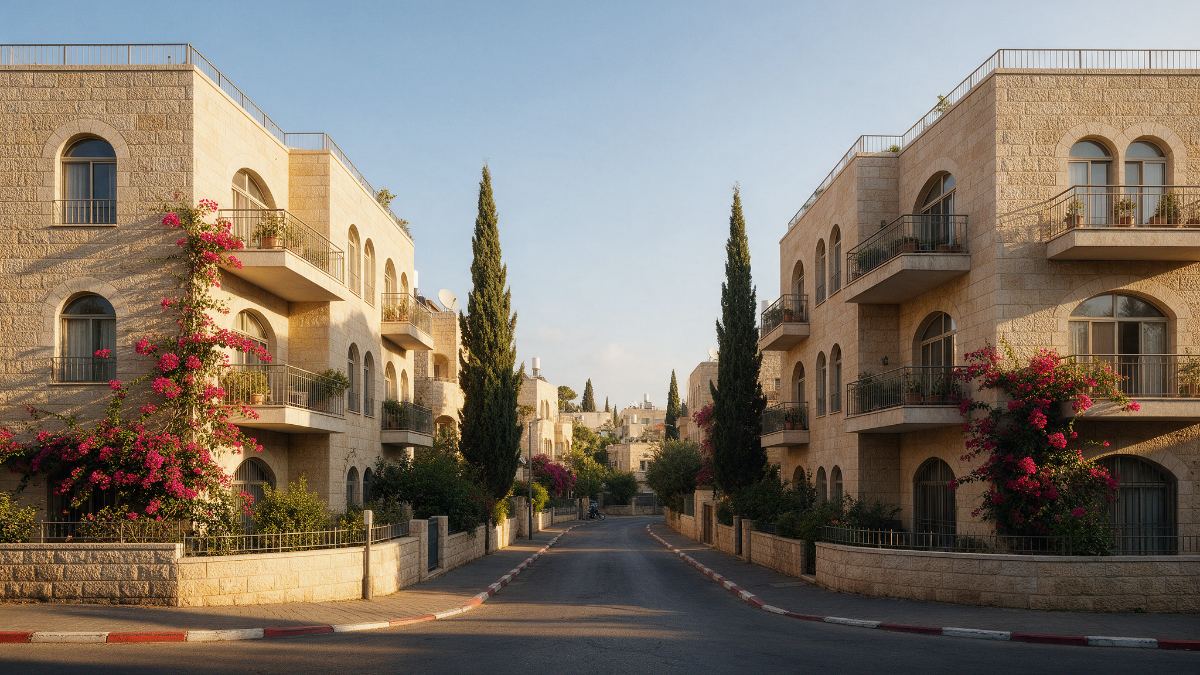
Buying in Rechavia, Talbieh (Jerusalem): 2026 prices, properties, due diligence
Rechavia (also spelled Rehavia) and Talbieh are Jerusalem’s historic upscale centre: tree-lined streets laid out in the 1920s, Bauhaus buildings in Jerusalem stone, the theatre, the President’s residence, twenty minutes on foot from the Old City. It is the most expensive neighbourhood in the city, the one where the diaspora buys its holiday apartments, and the one where title deserves the most attention: part of the neighbourhood sits on Greek Orthodox Church land leased until 2051.
The short answer
In Rechavia and Talbieh, resale trades between ₪50,000 and ₪60,000 per m² in 2026 and boutique new builds between ₪65,000 and ₪85,000: a 3-room, 75 m² apartment is worth ₪3.8–4.5M, a 4-room, 100 m² apartment ₪5–6M (≈ $1.4–1.7M), a renovated 5-room with garden or terrace ₪6.5–9M. On a 4-room unit at ₪5.5M a non-resident pays 440,000 ₪ in purchase tax (mas rechisha), a resident buying their only home 170,538 ₪, an oleh 17,606 ₪. Two checks separate two neighbouring buildings: Church land (lease until 2051, 10–25% discount) and heritage listing (renovation under control, no elevator or added floor without consent).
The figures to remember, November 2026
- ₪/m² resale
- 50,000–60,000
- ₪/m² new / boutique
- 65,000–85,000
- 4 rooms, 100 m² gross
- ₪5–6M
- Church-land discount
- 10–25%
- Purchase tax, non-resident, on ₪5.5M
- 440,000 ₪
- Gross rental yield
- 2.5–3%
The neighbourhood: Rechavia and Talbieh
Rechavia was laid out in 1922 by the architect Richard Kauffmann as a garden suburb for the Mandate’s academics and civil servants: quiet streets named after medieval rabbis (Ramban, Ibn Ezra, Radak, Alfasi, Abarbanel), three- to four-storey buildings in Jerusalem stone, including some thirty listed Bauhaus buildings from the 1930s. The commercial spine is Aza Street (Gaza Street) with its cafés, continued by Keren Kayemet and Ussishkin streets; King George Street and downtown are five minutes on foot, Jaffa Gate and the Old City twenty, the light rail (King George or City Hall stops) ten. The future Blue Line of the light rail is planned along Aza Street and Keren HaYesod.
Talbieh, to the south-east, is even more residential: 1920s–30s Arab villas around Hovevei Zion, Marcus and Disraeli streets, the Jerusalem Theatre, the President’s residence, consulates, the Lion’s park. It joins Mamilla and the King David hotel via Keren HaYesod. Community life is dense and largely English-speaking: Yeshurun and the Great Synagogue on King George, Ramban on Ramban Street, Hazvi Yisrael in Talbieh, with Modern Orthodox, Conservative and Reform options within walking distance. Population: academics, professionals, retirees, and a high share of owners living abroad.
Property types and prices by size
Four families of property coexist, at very different prices for the same area. Apartments for sale in Rechavia are counted in rooms, Israeli style: a "4-room" has three bedrooms and a living room.
| Property | Gross area | 2026 price | What to know |
|---|---|---|---|
| 2 rooms, 1950s–70s building | 50–60 m² | ₪2.6–3.3M | The typical pied-à-terre; often no elevator or parking. |
| 3 rooms, 1930s–60s stone building | 70–85 m² | ₪3.8–4.8M | High ceilings, balconies; renovation under control if listed. |
| 4 rooms, 1960s–80s building with elevator | 95–115 m² | ₪5–6.5M | The family product; parking rare, no safe room unless added. |
| 4–5 rooms, boutique project or recent added floor | 110–150 m² | ₪7.5–12M | Elevator, parking, safe room, terrace; ₪65,000–85,000 per m². |
| Arab villa or villa floor, Talbieh | 150–300 m² | ₪10–25M | A discreet market, often listed, with garden; diaspora buyers. |
Price per m² is quoted on gross area (walls, balconies, share of common areas): a 4-room apartment listed at 100 m² offers 80 to 85 m² of living space, about 860–915 sq ft (see gross vs net square meters). In Rechavia more than anywhere, two apartments of equal size on the same street can differ by ₪1.5M depending on title (freehold or Church lease), the elevator and the listing status.
Who buys in Rechavia and Talbieh
The neighbourhood is the diaspora’s first market in Jerusalem: buyers from New York, London, Toronto, Paris or Geneva who want an apartment for the holidays and summer, within walking distance of the Old City and the hotels. This has a visible consequence: the dirot refaim ("ghost apartments"), occupied a few weeks a year. The municipality counts several thousand of them in Rechavia, Talbieh and the centre, and since 2024 applies a higher arnona (municipal tax) rate to empty homes. For a buyer this means quiet buildings, building committees (vaad bayit) that can be slow to act, and a resale market aimed at the same foreign public, hence less sensitive to Israeli interest rates.
Add affluent Israeli families attached to the centre, retirees trading a suburban house for a 4-room apartment with an elevator, and investors targeting 2–3 room units to rent to Hebrew University students (Givat Ram campus fifteen minutes away) and visitors. Gross yield stays low, 2.5 to 3%; the neighbourhood is priced for its heritage value, not its income.
Worked example: a 4-room apartment bought by a non-resident
| Price | ₪5,500,000 |
| Purchase tax, non-resident (8% up to ₪6,055,070) | 440,000 ₪ |
| Lawyer (0.5 to 1% + VAT) | ≈ ₪48,000 |
| Agency (2% + VAT) | ≈ ₪130,000 |
| Mortgage broker, appraisal, bank fees, insurance | ≈ ₪25,000 |
| Translations, power of attorney, apostille, wires | ≈ ₪6,000 |
| Total cost | ≈ ₪6,149,000 (+ 11.8%) |
| Mortgage at 50% | ₪2,750,000 → ≈ ₪15,600 / month over 25 years |
| Cash to plan for | ≈ ₪3,399,000 (≈ $944,000 / £740,000) |
The same apartment bought by a resident as their only home would carry 170,538 ₪ in tax; by an oleh hadash, 17,606 ₪. Above ₪6,055,070 the 10% bracket applies to a non-resident: a 5-room unit at ₪7M costs ₪578,900 in purchase tax. Unlike a US closing, there is no title insurance, escrow fee or transfer tax beyond this. The full schedule is in mas rechisha 2026, and 50% financing in mortgages for non-residents.
Neighbourhood-specific due diligence: Church land, preservation, TAMA 38
- Greek Orthodox Patriarchate land. Part of Rechavia (the Ramban, Keren Kayemet, Ibn Ezra and southern Aza sector) and Talbieh, as well as Nayot, sits on land the Church leased in 1951–52 to the KKL for 99 years, until 2051. In the 2010s the Patriarchate sold these plots to private companies (Nayot Komemiyut Investments among others). The buyer acquires a leasehold right, registered at the Tabu as hachira (lease); the lawyer reads the Tabu extract (nesach tabu), identifies the current lessor, checks the renewal clauses and explains what remains unknown. Expect a 10–25% discount, banks that sometimes cap the loan term at the expiry date, and a buy-back file still open between the State, the municipality and the owners.
- Listed buildings. A large share of Rechavia and Talbieh buildings is on the municipality’s preservation list: façades, stairwells, window frames and sometimes interior volumes are protected. Before buying to renovate, ask the planning department for the listing grade; an external elevator or an enclosed balcony may be refused.
- TAMA 38 and added floors. The national seismic-reinforcement programme (TAMA 38) allows extra floors in exchange for strengthening; the municipality has sharply restricted it on the neighbourhood’s listed buildings. An apartment "with building rights" is worth something only if the project is feasible: demand the planning file (tik binyan) and the co-owners’ consent.
- Unpermitted additions. Rooftop rooms, enclosed balconies, converted basements, split units: common in 1950s–70s buildings. Compare permit and reality; regularise before signing or price it in.
- Old co-ownerships. Many Tabu registers were never updated (common areas unallocated, parking or garden not attached). The lawyer checks that what you are sold is actually registered on the unit.
- No zikaron dvarim without a lawyer. The pre-agreement is binding, even on a property whose title has not been read yet. Fees and the city-specific checks are in real estate lawyer in Jerusalem.
Renting out in Rechavia: long or short term
Long term, a renovated 3-room apartment rents for ₪7,500–9,500 a month, a 4-room for ₪9,500–13,000, a gross yield of 2.5 to 3%, below the city average. Demand comes from Hebrew University students and researchers, diplomats, doctors at Shaare Zedek and Hadassah, and families waiting for a delivery elsewhere. Short term, a well-placed 2–3 room unit makes ₪500–900 a night over the holidays and summer, but only if the building allows it; the income then falls under the real tax regime rather than the 10% flat rate, and arnona may switch to a non-residential rate. Rental tax rules for an owner living abroad are detailed on shekelguide.com.
Frequently asked questions
What is the price per square metre in Rechavia in 2026?
Between ₪50,000 and ₪60,000 per m² for resale (1930s–70s buildings, renovated or not), and ₪65,000 to ₪85,000 per m² in the rare new or boutique projects, according to Madlan listings and declared transactions. That is roughly $1,290–1,550 per sq ft for resale. A property on Church-leased land trades 10 to 25% below those ranges. Talbieh, more residential, sits at the top of the range, especially around Jabotinsky Street and the theatre.
What is the Church land issue in Rechavia?
Part of Rechavia, Talbieh and Nayot stands on land owned by the Greek Orthodox Patriarchate, leased in 1951–52 to the Jewish National Fund (KKL) for 99 years, so until 2051. In the 2010s the Patriarchate sold these plots to private companies, creating uncertainty about renewal terms. The buyer acquires a leasehold right, not the land. Banks lend, but often on a term aligned with the expiry; the discount is 10 to 25%, and a partial buy-back negotiated between the municipality, the State and the owners is still under discussion.
Can I buy in Rechavia for short-term rental?
Legally, yes: Jerusalem does not ban short-term lets, but the building’s by-laws may exclude them, arnona switches to a non-residential rate if the unit operates as lodging, and the income falls under the real tax regime rather than the 10% flat rate. In practice, 2–3 room units near Aza Street and Mamilla let well to holiday visitors, provided the building allows it.
Is there any new construction in Rechavia and Talbieh?
Very little: much of the neighbourhood is listed, and the municipality restricts TAMA 38 (adding floors) on protected buildings. New stock comes from a few boutique projects of 6 to 12 apartments on freed-up plots, sold at ₪65,000–85,000 per m², and from permitted additions on 1960s–70s buildings on Ben Maimon, Ussishkin or Hapalmach streets.
How we work
Every amount, bracket and rate on this page is checked against the official source listed at the bottom and dated. When a schedule or rate changes, the page is updated within days. Our methodology.
Sources
A property in Rechavia or Talbieh?
Agency, lawyer or broker: tell us the street or sector, the size you are after and your status (resident, non-resident, aliyah planned). We pass it to an English-speaking professional who knows the neighbourhood’s buildings and their titles.